Management institutes prepare students into managers for the industry through well established methods. I had the opportunity to share my perspectives on this topic to a group of management faculty based on my experience as a practitioner, teacher and student. I am sharing a gist of my talk here.
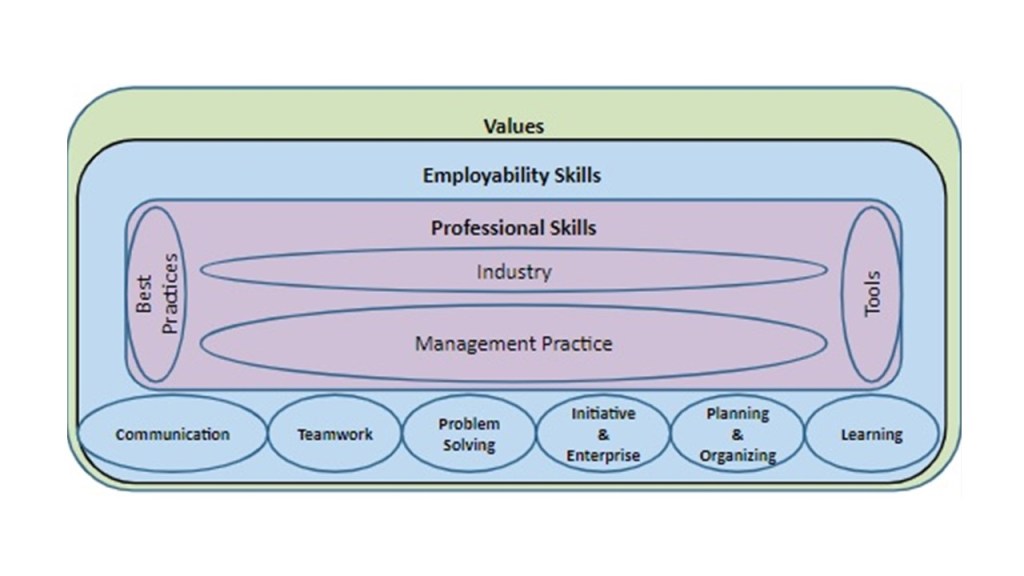
What does it take to be an industry-ready manager?: I have summarized what I found published and what I could relate to based on my experience in the picture above. At the core is the value system. Values serve as the canvas for any profession and management is no exception. For example, ‘Integrity’ is a value which is expected of every manager. I have grouped the skills into ‘Employability Skills’ and ‘Professional Skills’. The employability skills are common across professions and I found a good grouping of these in a published report (Gibb, J. (2004). Generic Skills in Vocational Education and Training: Research Readings. National Centre for Vocational Education Research (NCVER)). They are Communication, Teamwork, Problem Solving, Initiative & Enterprise, Planning & Organizing and Learning skills. I have grouped the professional skills required for managers into ‘Management Practice’, Tools and Best Practices. These can be viewed in two parts – Generic and Industry-specific as different industries have their specific needs and the management concepts, techniques and practices get evolved for their specific context. Besides these three professional skills, an awareness of the industry in which the management professional is working is key to be successful.
With this backdrop on what it takes, let us dwell into how to enable management students become industry-ready. It is well accepted practice in good management institutes to weave experiential learning with conceptual learning. I had the chance to see this really work in my experience of grooming project managers on the job and teaching them the concepts in an internal project management academy setting within my organization. The typical coursework in management institutes covers the concepts very well coupled with assignments and case discussions. I would like to emphasize on the industry immersion through internships and live industry projects. The success of this will depend on the involvement of the industry sponsor/advisor, the faculty identified and the student. Sufficient time should be provided for the industry immersion with appropriate credits. Besides these, students need to be connected with industry leaders through forum like expert talks and mentorship programs. Internal societies/clubs are also a great way to create industry-like experience within campus. Students will have to carefully choose the industry they would like to focus on and pick the projects/internships accordingly. Professional certifications by industry forums do help in many cases. Students should consult industry leaders/mentors in choosing these considering the returns for their efforts and money invested.
I hope this information is useful to the management faculty and management students. Look forward to your views, comments and any additional inputs.
 Dr. Selvaraj Vadivelu