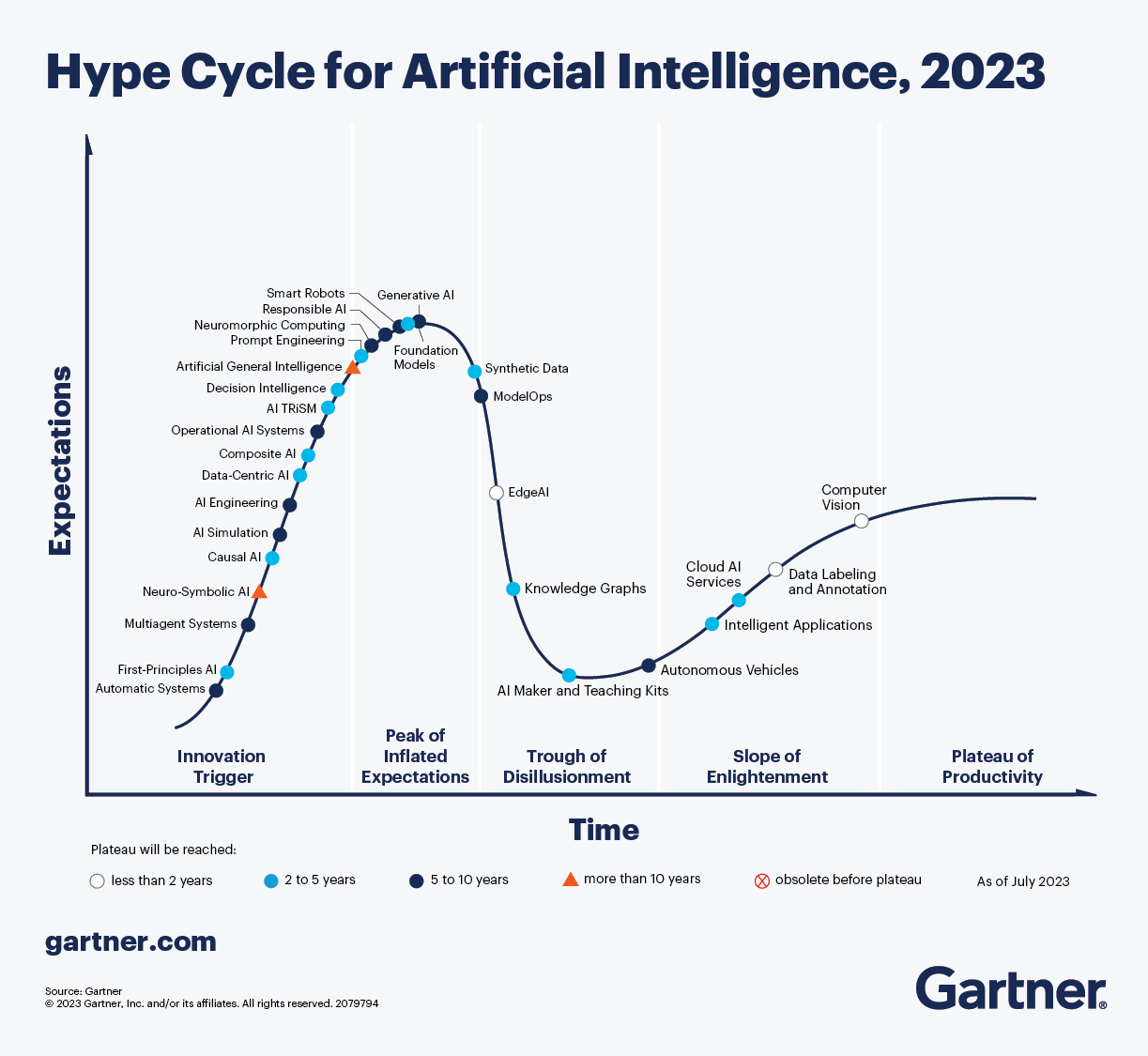
The Gartner Hype Cycle is a visual framework that tracks the evolution of new technologies — from innovation to mainstream adoption. It illustrates the expectations, visibility, and maturity of emerging technologies over time.
Understanding the Hype Cycle is crucial to:
- Evaluate when to invest in or adopt a technology.
- Manage risks associated with early adoption.
- Identify opportunities for competitive advantage.
- Avoid being misled by market hype.
The Five Phases of the Hype Cycle

| Phase | Description | Managerial Considerations |
|---|---|---|
| 1. Innovation Trigger | A breakthrough, public demo, or R&D success sparks interest. No proven products yet. | Watch for startups, patents, academic research. |
| 2. Peak of Inflated Expectations | Media and analysts fuel enthusiasm. Few successes, many failures. | Avoid over-investing; run pilot projects. |
| 3. Trough of Disillusionment | Reality sets in as implementations fail to meet expectations. | Identify viable use cases; continue monitoring survivors. |
| 4. Slope of Enlightenment | Technology matures, lessons are learned, 2nd/3rd-gen products appear. | Start adoption in non-critical processes. |
| 5. Plateau of Productivity | Mainstream adoption begins, standards emerge, ROI is measurable. | Scale investments strategically. |
Indicators of Stages

Real-World Technology Examples
| Technology | Hype Cycle Phase (approx.) | Notes |
|---|---|---|
| Generative AI (e.g., ChatGPT, MidJourney) | Peak of Inflated Expectations (2023–2024) → moving toward Trough (2025) | High adoption but challenges in governance, accuracy, bias. |
| Blockchain for Supply Chain | Trough of Disillusionment | Early hype faded; practical pilots in trade finance/logistics. |
| Quantum Computing | Innovation Trigger | Still largely R&D; real applications decades away. |
| 5G & Private 5G Networks | Slope of Enlightenment | Clear ROI in manufacturing, logistics. |
| Cloud Computing | Plateau of Productivity | Mature technology; business-critical infrastructure. |
Case Study: Blockchain in Financial Services
- 2016–2017: Hype Peak — Blockchain was hailed as a revolution to “replace banks.”
- 2018–2020: Trough — Many pilots failed due to scalability and regulatory challenges.
- 2021–2024: Enlightenment — Focus shifted to specific use cases (trade finance, cross-border payments).
- 2025 onward: Moving toward Plateau — Some financial institutions now use blockchain-based settlement networks at scale.
Managerial Insight: Early hype led to overinvestment. The winners were firms that experimented cautiously, learned, and invested in targeted use cases once the ecosystem matured.
Strengths and Limitations
Strengths
- Provides a simple visual framework for decision-making.
- Encourages a portfolio view of emerging technologies.
- Useful for executive discussions on innovation timing.
Limitations
- Qualitative; based heavily on analyst judgment.
- Not all innovations follow the curve predictably.
- Can vary by industry and geography.
- Risk of misinterpretation (e.g., technologies in the “Trough” may be wrongly discarded).
- 8 Lessons from 20 Years of Hype Cycles (A good article on the lessons learnt from analysis of the Hype Cycle of various technologies).
Adoption Patterns
| Type | Adoption Timing | Profile | Pros | Cons | Examples |
|---|---|---|---|---|---|
| Type A – Aggressive Adopters | Early (Innovation Trigger → Peak of Inflated Expectations) | Risk-taking, innovation-driven, seek first-mover advantage | – Potential market leadership- Brand differentiation- Learn ahead of competitors | – High risk of failure- High cost of experimentation- ROI uncertain | Tesla (autonomous driving), Google (Quantum Computing, AI) |
| Type B – Pragmatic Adopters | Middle (Trough of Disillusionment → Slope of Enlightenment) | Balanced, pragmatic, ROI-focused | – Benefit from lessons learned by Type A- Lower risk of failure- Adopt mature versions | – Lose first-mover advantage- May face higher entry costs as market consolidates | Banks (Blockchain pilots after hype), Manufacturers (IoT after standards emerged) |
| Type C – Conservative / Late Adopters | Late (Plateau of Productivity) | Risk-averse, cost-sensitive, compliance-driven | – Minimized risk- Technology proven & standardized- Lower training/transition costs | – Miss out on competitive advantage- Often reactive, not proactive- Risk of disruption from rivals | Public sector (late Cloud adoption), Small firms (late ERP adoption) |
Implications for Managers
- Use the Hype Cycle to balance hype and reality.
- Apply scenario planning: consider both early adoption and wait-and-see approaches.
- Align adoption timing with strategic objectives and risk appetite.
- Remember: Being too early can be as costly as being too late.
Illustration of one Hype Cycle for AI
 Dr. Selvaraj Vadivelu