| Knowledge Area | Initiating | Planning | Executing | Monitoring & Controlling | Closing |
| Cost Management | Plan cost management, Estimate costs, Determine budget | Control Costs |
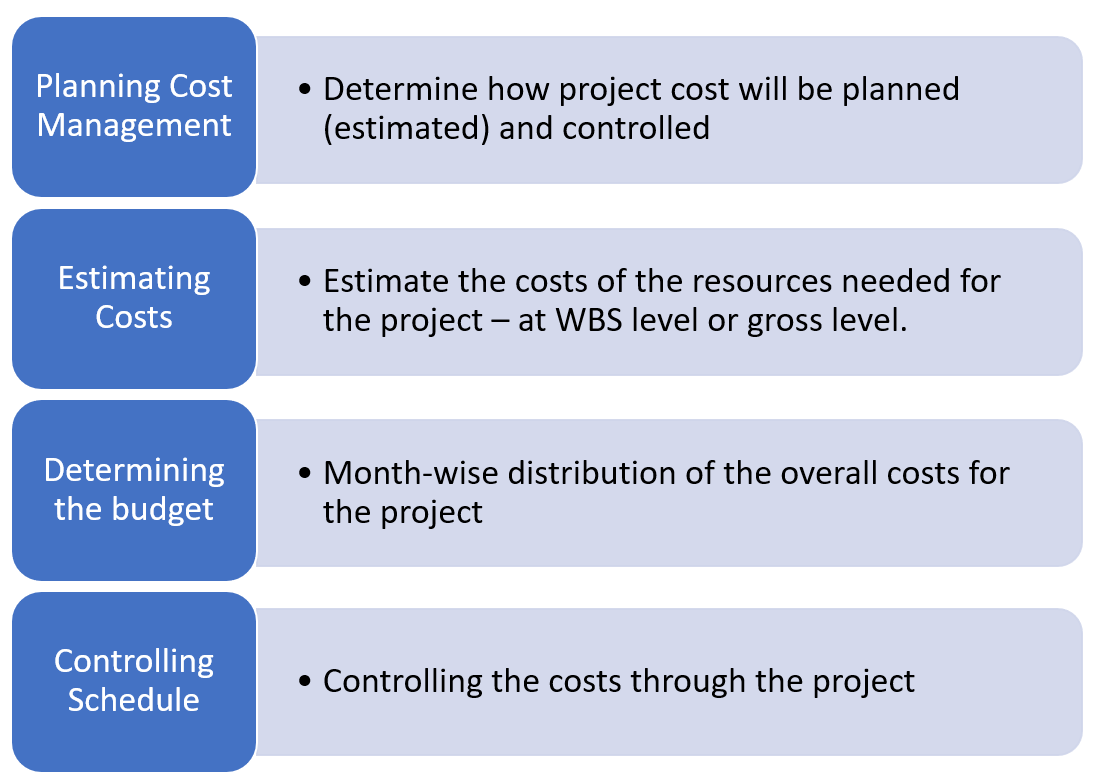
Cost Estimation
Estimate of the total cost for the project
- What are the items that contribute to the cost?
- Hardware, Software, Tools, SW Engineering Activities, Pilot, Deployment, Training, Travel and so on.
- What are the types of IT projects (from software engineering scope perspective)?
- Development; Enhancement; Sustenance (including support); One/more lifecycle steps (E.g. Testing only)
- What are the different types of Software Engineering activities?
- Varies with type of the IT project
- What are the data benchmarks available based on historic data?
- Benchmarks can be at Organization level / Industry level. Typical benchmark information and interpretation: Min, Max, Q1, Q2, Q3, Mean and Std Dev. Metrics required will be in terms of productivity, size, number of defects expected, number of test cases required.
An approach to estimation of cost of Software Engineering activities using human resource effort estimate
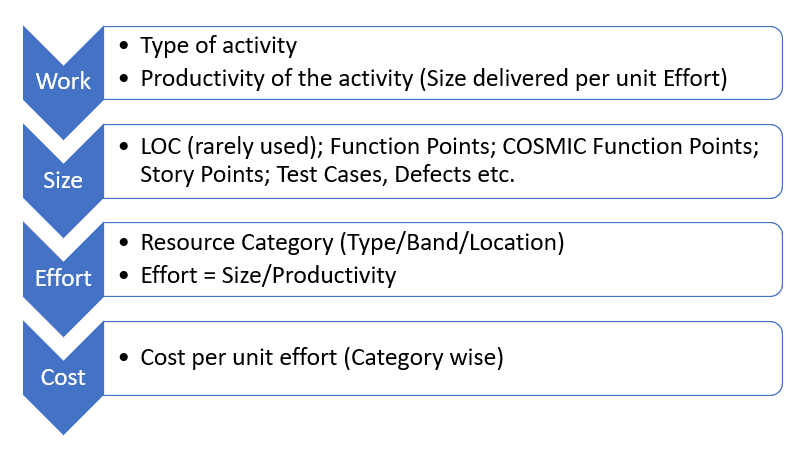
Estimation Approaches

Earned Value Management (EVM)
EVM is a good approach to track cost and schedule in a project. It is elaborated in Earned Value Management.
Activity: Find the total effort estimate for the below scenario
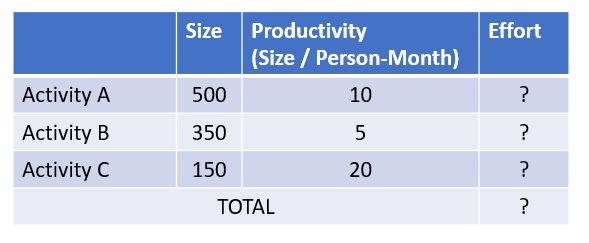
Activity: In the following scenario, estimate the total human resources cost?
- Architecture and Design are existing
- A feature is to be added (Estimated size of that feature is 300 Function Points)
- In the organization, the Function Point Productivity is 0.2 FP/Person-Hour
- The blended cost per Person-Month of effort is 3300$
Activity: In the below scenario, what will be the estimate of total effort for the project?

Activity: In the below scenario, what is the estimate of total human effort that you will go with? What is the effort estimate for which the confidence of meeting the planned estimate (or) budgeted estimate is 70%?
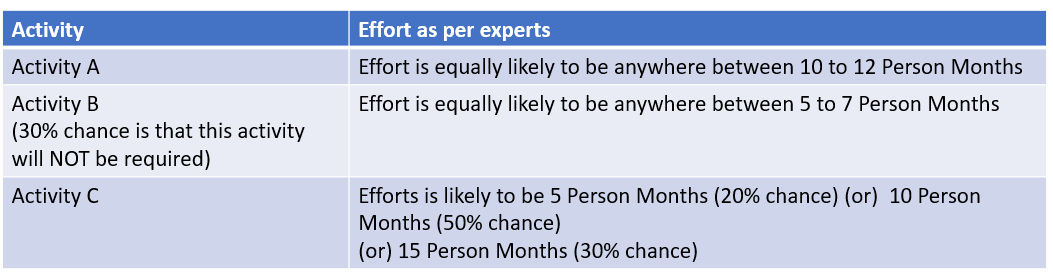
Project Cost Estimation Discussion Scenarios
How do we estimate productivity?
Benchmarks
How do we estimate the size?
FP (procedure available);
# of Test cases (Benchmarks; E.g. 6 test cases per requirement line item);
# of Defects (Defect models; Defect rate Benchmarks (Defects/size); S – curve used for maturity);
Some modules/solutions will be more complex than others. How do we handle this?
•Complexity is influencing the productivity and other benchmarks
•If benchmark for that category is not available?
•Use a scale factor
A team can have people of various bands (ie proficiencies). How do we handle this in estimation of total efforts?
•Team level Productivity and other benchmarks are already factoring a typical team profile
•Let us assume that there is a risk of higher defect rate due to a new technology and complex product. How do we handle this?
•Increase defect size accordingly.
•Estimation in Sustenance project in output based pricing model
•Fixed rate per ticket (Category-wise) with SLAs on TAT. How do we determine the fixed rate
How do we address a bunch of risks identified at the time of estimation?
•Compute the impact (in terms of efforts – after considering the probability of occurrence) and add that into the other activities for which estimation is being done.
How do we add a reserve to the total effort estimate?
•Don’t add reserve in every activity
•Add one reserve considering the typical effort overruns
Why do projects have cost overrun?
•Under-estimates: Lower size estimate or Higher productivity estimate
•Poor Project Management:
•Slipping on dependencies
•Scope Creep Bad quality – Repeat work
•Effort metrics
•Effort deviation as a percentage of the total efforts
•CPI & CV (EVM metrics using effort units).
There are variety of methods of estimation. How do I choose which one to use?
•Understand the scope and context (e.g. pricing model of the project) and decide what is best. Hybrid approach is appropriate manytimes.
•Organizations typically have a certain standard method and then cross check the estimates with multiple approaches. E.g. Estimate using Bottom up method. Cross check effort distribution across each phase.
How do we analyze the deviations in efforts and learn from that?
•Setup a smart tracking mechanism for size of work and actual effort expended. Compute the productivity achieved
•Check against estimate – what is the cause for the deviation and either update benchmarks or capture learning for future projects
 Dr. Selvaraj Vadivelu