
Types of Elicitation Techniques
Requirement Elicitation techniques are grouped into three: Collaborative, Research and Experiments.

Collaborative Techniques
Involves direct interaction with stakeholders, and relies on their experiences, expertise, and judgment (Facilitated Activities)
•Interviews: Establish rapport; Stay focused; Prepare questions ahead; Suggest ideas; Listen!
•Focus Groups: used to identify and understand ideas and attitudes from a representative set of members in a group (users). Good for Functional and Quality Requirements.
•Brainstorming: used to generate many ideas from a group of stakeholders in a short period, and to organize and prioritize those ideas
•Mind Mapping: used to capture points/ideas generated typically in Brainstorming type of sessions, and to organize and prioritize those ideas.
•Survey Questionnaire: used to elicit business analysis information, including information about customers, products, work practices, and attitudes, from a large group of people in a structured way and in a relatively short period of time.
•Workshops: used to elicit business analysis information, including information about customers, products, work practices, and attitudes, from a group of people in a collaborative, facilitated way. Staying focused and keeping everyone engaged are challenges. Use Parking lot option to deal with areas which do not converge or those which need further discussion. Enables quick turnaround – as all stakeholders are available!
Research Techniques
Involves systematically discovering and studying information from materials or sources that are not directly known by stakeholders involved in the change. Research can include data analysis of historical data to identify trends or past results. (Independent Activities)
•Document Analysis: used to review existing systems, contracts, business procedures and policies, standards, and regulations. People may not know business logic/rules/policies
•Business Rules Analysis: used to identify the rules that govern decisions in an organization and that define, constrain, or enable organizational operations
•Interface Analysis: used to understand the interaction, and characteristics of that interaction, between two entities, such as two systems, two organizations, or two people or roles.
•Process Modelling: used to elicit processes with stakeholders during elicitation activities.
•Process Analysis: used to understand current processes and to identify opportunities for improvement in those processes.
•Benchmarking: Comparison with competitors/best in class; Time consuming and high cost.
•Market Analysis: Customers needs/preferences; Understand what they need; Time consuming and high cost
Experimental Techniques
Involves identifying information that could not be known without some sort of controlled test (Experiment) because it is unknown. Experiments include observational studies, proofs of concept, and prototypes.
•Observation: used to gain insight about how work is currently done, possibly in different locations and in different circumstances
•Prototyping: used to elicit and validate stakeholders’ needs through an iterative process that creates a model of requirements or designs.
Summary of Elicitation Techniques
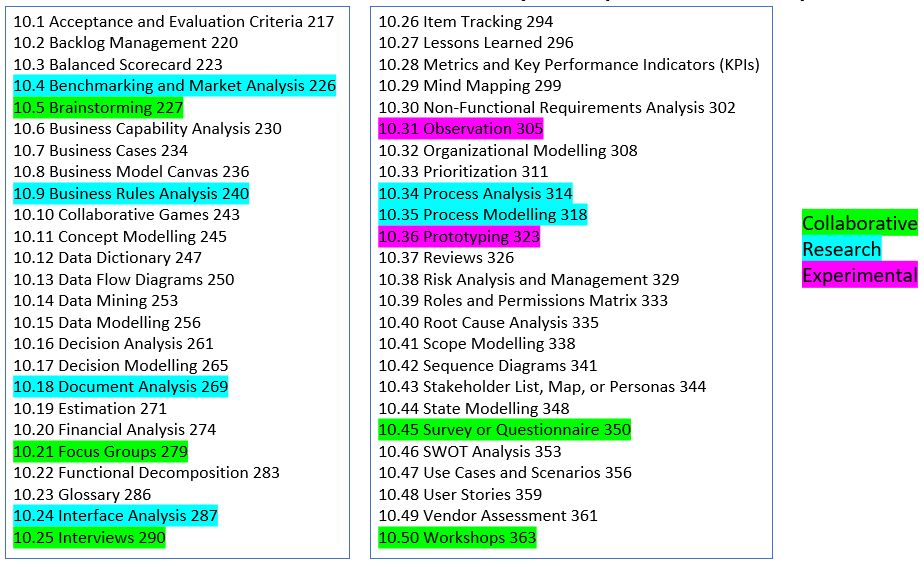
Selecting Elicitation Technique(s)
Typical Considerations:
- Cost & time constraints
- Types of business analysis information sources and their access
- Culture of the organization, and Desired outcomes.
- Needs of the stakeholders, their availability, and their location (co-located or dispersed)
- Techniques commonly used in similar initiatives,
- Techniques specifically suited to the situation, and Tasks needed to prepare, execute, and complete each technique.
Multiple techniques may be required in a project. As we discover details during the project, we might require usage of more appropriate techniques

Exercise for Identification of Elicitation Technique(s):
Identify the elicitation technique(s) suitable for the following scenarios:
- A not-for-profit Industry forum would like to create an industry-wide corporate performance benchmarking system development for the various corporate functions.
- Unified Helpdesk for an organization: Understand the expectations for a unified helpdesk (call logging and chatbot) from users within the organization, identify gaps in the currently available mechanisms and recommend a solution.
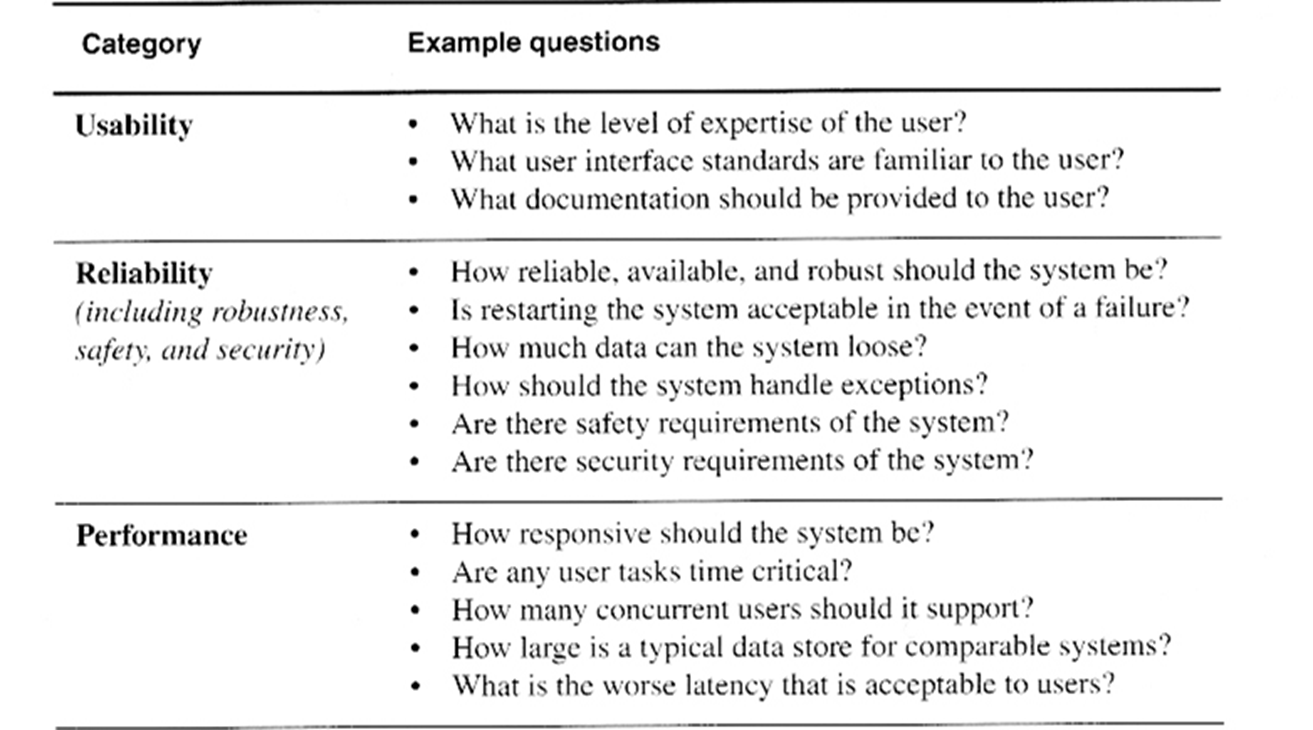
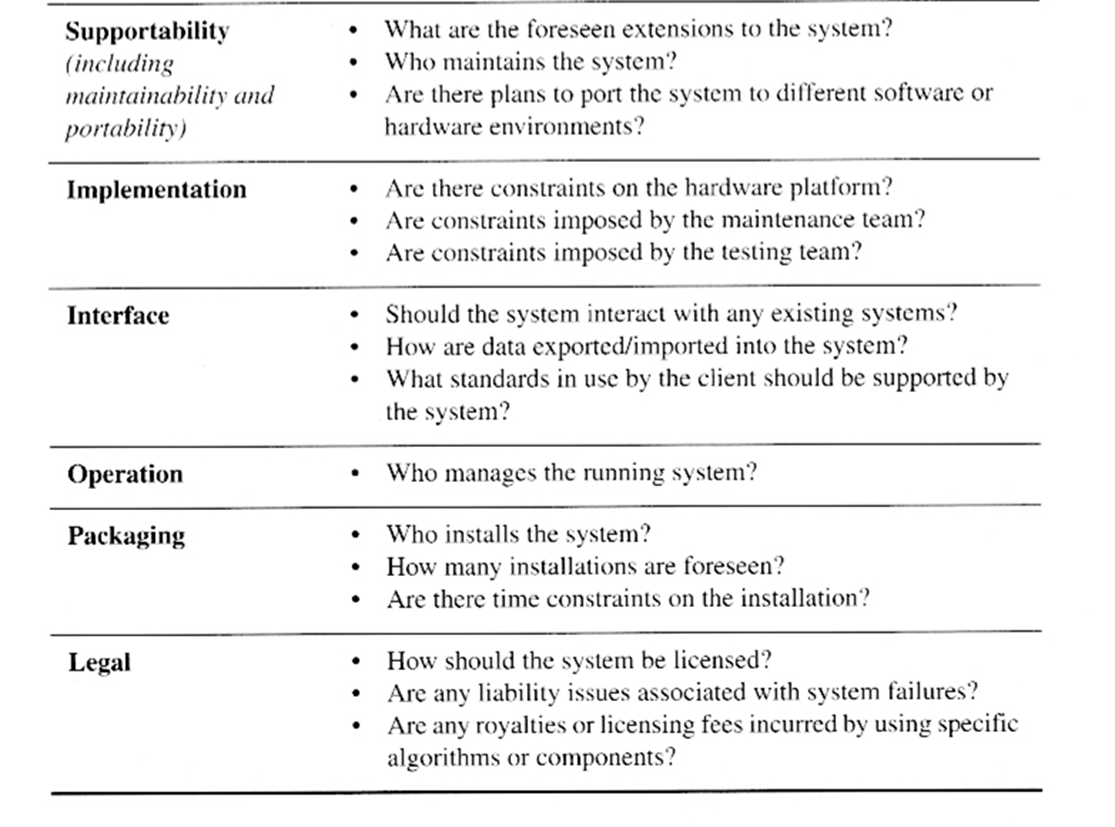
Elicitation of Non-Functional Requirements
Non-Functional Requirements (NFR) are difficult to elicit relatively. Here are a few questions to ask while eliciting NFR. (Source Link)
Classification of the Requirements during and at the end of Elicitation
Requirements can come in any order and it is the Business Analyst’s responsibility to classify them and document.

 Dr. Selvaraj Vadivelu