Business Analysis
The practice of enabling change in an enterprise by defining needs and recommending solutions that deliver value to stakeholders
It enables an enterprise to:
- Articulate needs and rationale for change
- Design and describe solutions that can deliver value

Business Analysis Core Concept Model (BACCMTM)
Each core concept is an idea fundamental to the practice of business analysis, and all the concepts are equal and necessary.
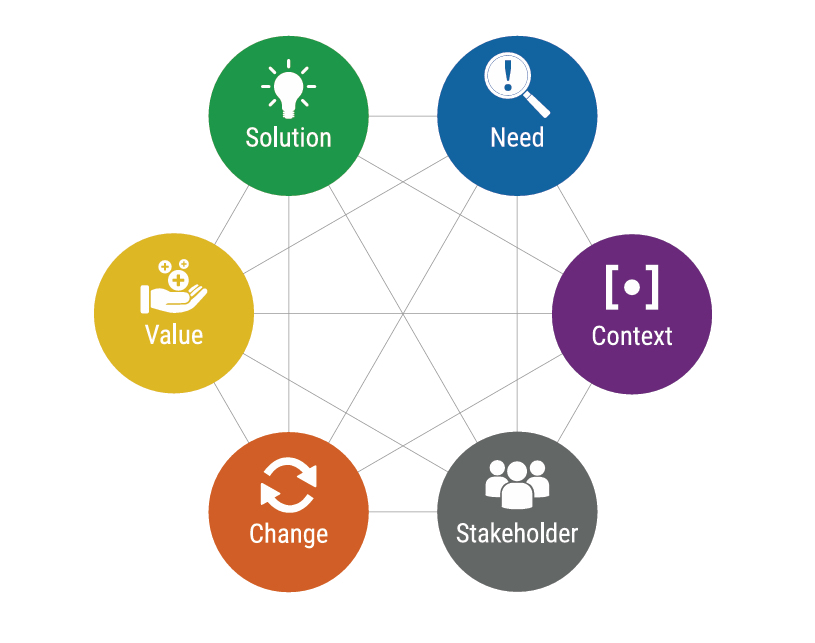
- Need: Problem to be addressed or Opportunity to be tapped
- Change: The act of transformation in response to a need to improve the performance of an enterprise
- Solution: The specific way of satisfying one or more needs in a context
- Stakeholder: A group or individual with a relationship to the change, the need or the solution.
- Value: The worth, importance, or usefulness of something to a stakeholder within a context.
- Context: The dynamic circumstances that influence, are influenced by, and provide an understanding of the change.
BA Knowledge Areas
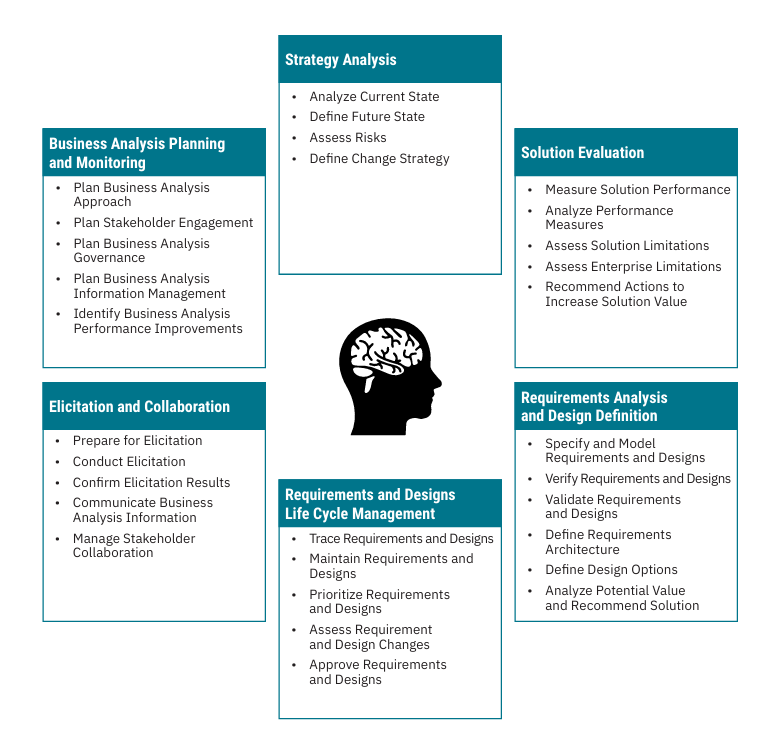
- Business Analysis Planning and Monitoring: organize and coordinate the efforts of business analysts and stakeholders
- Strategy Analysis: collaborate with stakeholders in order to identify a need of strategic or tactical importance (the business need)
- Elicitation and Collaboration: prepare for and conduct elicitation activities and confirm the results obtained
- Requirements Analysis and Design Definition: structure and organize requirements, specify and model requirements and designs, validate and verify information, identify solution options, and estimate the potential value of each option
- Requirements Lifecycle Management: manage and maintain requirements and design information from inception to retirement.
- Solution Evaluation: assess the performance of and value delivered by a solution in use by the enterprise.
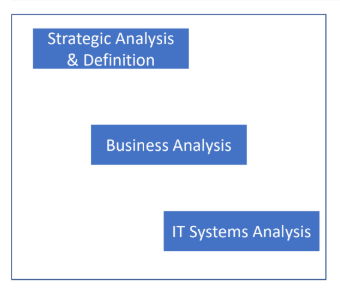
Business Analysis Process

Business Analysis Career Progression

Typical Career Path
Entry level business function specialist –> Requirements Analyst –> Business Analyst –> Change Management Analyst –> PM
Entry level programmer/analyst –> Systems Analyst –> Software Architect –> Business Analyst / Pre-Sale Management
ACTIVITY: Go through job descriptions of business analyst roles and understand the scope the role in various organizations and industries.
Foundational Competencies for Business Analysis professionals
The following are considered essential foundational competencies by industry professionals (Ref: Business Analysis Standard V2.0 (IIBA(R)))
- Adaptability: Adjusting behavioural style to increase effectiveness
- Facilitation: Facilitating workshops, negotiating, and helping resolve conflicts
- Leadership and Influencing: Building consensus, recommending solutions, and guiding stakeholders to the desired value
- Problem Solving: Ensuring that created value addresses the root cause of problems
- Systems Thinking: Holistically understanding the enterprise and context to maximize the value delivered
BA Tools and Techniques
In any profession there are tools and techniques which help the professional to improve his/her productivity and quality. While there are a variety of tools and techniques required for Business Analysis, the following are specifically called out and elaborated in BABoK. Besides this generic set, there will be domain/industry specific tools and techniques required as per the context.

References
- Business Analysis Standard V2.0 (IIBA(R))
- BABoK-Business Analysis Body of Knowledge, IIBA V3
- Paul, D., Cadle, J., & Yeates, D. (Eds.). (2014). Business analysis. BCS, The Chartered Institute for IT.
- Cadle, J., Paul, D., & Turner, P. (2010). Business analysis techniques: 72 essential tools for success. BCS, The Chartered Institute
- Milani, F. (2019). Digital business analysis (pp. 1-429). Basel, Switzerland: Springer International Publishing.
- https://babook.cs.ut.ee/materials/
 Dr. Selvaraj Vadivelu