Consulting Process: It is about the way of, Winning a consulting project, Delivering the consulting service, Realizing value maintaining long-term relationship and finally creating and reusing knowledge assets.
Key process steps
- Prospecting, Qualifying, and Preparing
- Understanding and Proposing
- Concluding Sale and Contracting
- Executing
- Recommending and Implementing
- Closing and Collecting
Prospecting
- Research and Target (E.g: Besides sales team, a dedicated marketing team to identify prospects)
- Reach out through industry conferences
- Tap professional network & contacts
- Leverage client references (E.g: A client referring their training partner to their other professional service providers; Within a product development ecosystem of an industry, a component vendor can refer a consulting agency to device manufacturers)
- Look out for tender notifications (Activity: Find some tender notifications. Are there any aggregator platforms?)
Qualifying (Why should we qualify a consulting opportunity/prospect?)
- Typical questions asked at this stage are: What is the consulting need of the prospect? Can we adequately address it? Can the prospect invest as needed in the engagement? Is the timeline suitable for both parties?
Preparing
- This step leads to the first meeting: Typically in the first meeting, the outcome can be:
- Client wants to take the discussion forward
- Client is convinced but needs to get a buy-in internally
- Client is not convinced
What can we do to get to the first step?
Understanding & Proposing
- Understanding the customer’s needs and Submitting a proposal
Proposal focuses on:
- Scope, Deliverables, Timelines, Responsibilities and KPIs (Discussion: Why are the KPIs important?)
- Methodology to deliver the consulting service
- Business Model: This consists of specifying the choices made in the way of working (Operating Model) and the way the client is charged for the services rendered (Pricing Model). Pricing model choices could be Outcome based or Hourly billing or Fixed price for a specified consulting scope
Concluding the sale and Contracting
- Proposal is accepted with/without changes
- Legal contract is signed with relevant appendices for scope, payment terms etc.
Execution
- Handover of the approved documents (E.g. Scope, Approach, Plan…) to the team delivering the consulting service
- Execution of the service
- Outcomes: As identified in the scope. Finalized recommendations, implementation approach and plans.
Typical steps in execution
- Business problems: Current state 🡪 Better State
- Consultants may need to help in documenting and benchmarking the current state (Why should we benchmark the current state)
- A business problem needs to be addressed from different perspectives
- Solution should cover both Business and IT actions
- Choice of the right set of analysis tools and frameworks
Execution Phases
Execution: Engagement Planning
- Defining and Documenting the Engagement Scope
- Crucial Role of the Engagement Manager
- Suggested Steps for Engagement Planning:
- Setup a comprehensive Engagement Governance Structure (What is the significance of this?)
- Plan the work, select the team, brief them (starter pack)
- Gather suitable intellectual capital for use
- Kick-off the engagement with client (Kick-off meeting)
- Do a team building exercise
- Conduct an objective-setting workshop
Execution: Definition Phase: As much detail as possible is collected about the problem and the problem is broken into its component elements to solve it faster and accurately
Execution: Data Gathering Phase:
- Understanding the current situation
- Typical data gathered: Organization structure (Roles & Responsibilities); Way of working (Flowcharts or process charts, Resources, etc..); Financial health of the organization or business unit in focus
Execution: Diagnosis Phase
- Defining Objectives and Performance Measures
- Assessing the Organisation, Internal and External Alignment E.g. SWOT, Porter’s Competitive forces etc.
- Developing and Testing Hypothesis
- Arriving at a confirmed diagnosis
Execution: Solution & Recommendation Phase and Concluding actions
- Solution & Recommendations
- Implementation Planning and Implementation Management Phase
- Evaluation of Results
- Managing change and Preparing the Organisation to Receive the New Solution
Implementation of the Recommendations
If the scope included implementation, then implementation will be done.
Completing Project and Collecting
- On fulfilling the scope of work as per the contract, the deliverables will be accepted, engagement will be signed off and closed (What are the challenges in closure of a project?)
- Payments will be collected by consulting firm (How is payment collection different from revenue recognition?)
- Feedback session with all stakeholders especially from client
Managing Follow-on Engagement & Continued Relationship
Repeat Business / Follow-on work is not merely desirable but essential (Builds Client Relationships, Develops expertise in client’s industry/product, Reduces selling efforts). This is considered a revenue growth option besides new opportunities/prospects generated by Marketing and Sales. Some of the possible options here are:
- Extension of current work
- Same client group or other groups
- Fixed–price projects (Change Requests)
Creating, Managing and Reusing knowledge assets
Capturing learning and intellectual assets internally (without violating any confidentiality requirements). Using this for continuous improvement of the process of delivering the consulting service offering, training, and reuse.
Activity: Identify possible Intellectual Property that can be created in a consulting services business.
Consulting Process Summary
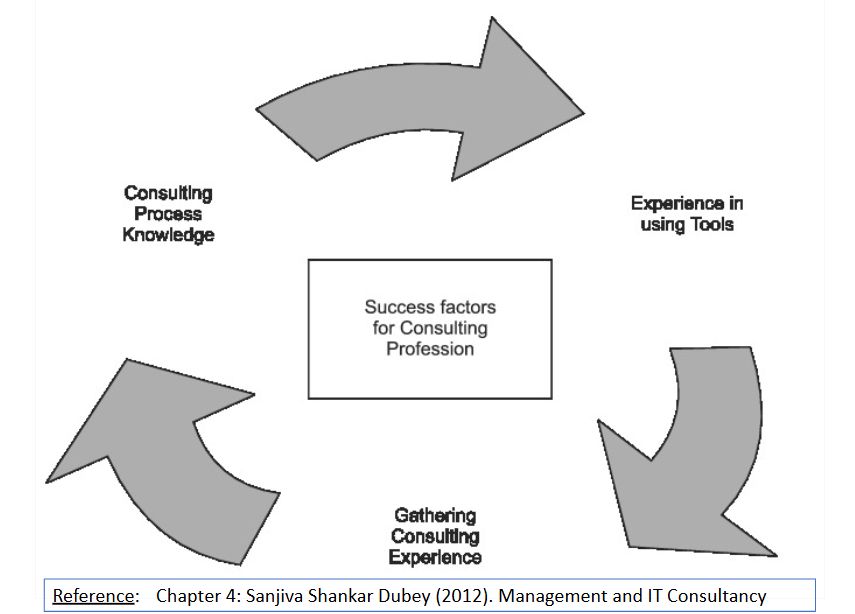
Discussion points:
Processes are to be used judiciously. Why?How are tools important?How to differentiate yourself (a consultant) from a mere expert?Should not jump to a conclusion. Why? How to come to conclusion?
 Dr. Selvaraj Vadivelu