A consultant brings in a professional approach to problem solving and this approach typically leans on well established frameworks and tools. While the list of frameworks and tools that can be used is long and ever growing, in this page we identify a few of those commonly used ones with a brief introduction to each of them. The content in this page and the pointers to other pages is expected to be enhanced regularly.
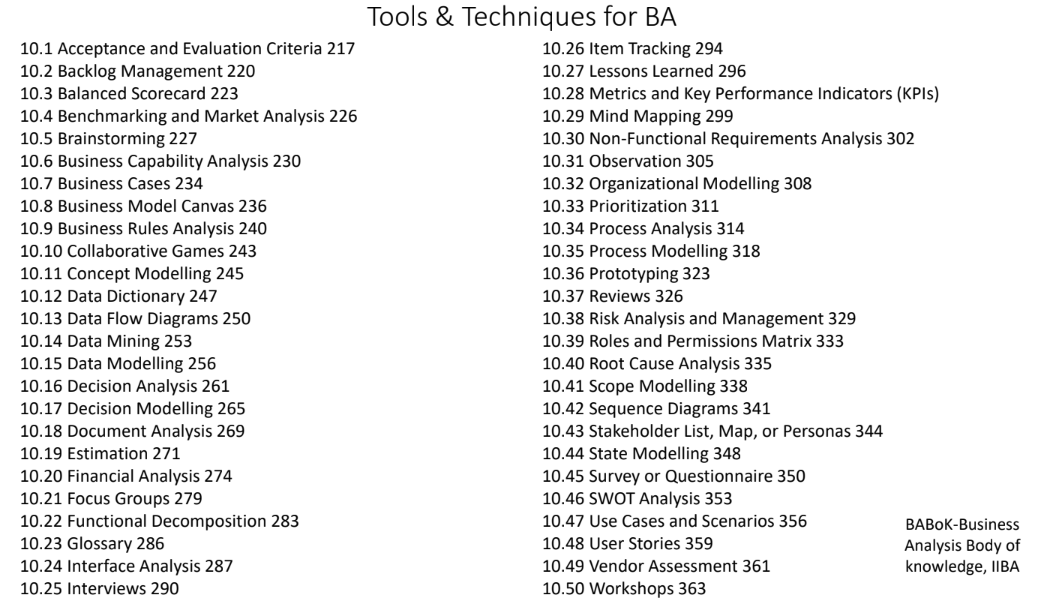
Business Analysis Body of Knowledge identifies a list of 50 techniques critical for any Business Analyst.
Root Cause Analysis (RCA) – Fix the root cause not the symptoms
Pareto Principle (80/20) – Key to Prioritization. Additionally, refer ASQ article on this.
Data Benchmarking: Data benchmarks of key metrics are useful for evaluating performance of any organization and for identifying meaningful targets. Data benchmarks can be created internally within an organization (or) within a particular business unit and so on. It could also be created across organizations to derive an industry data benchmark. Standards bodies and Consulting firms create and publish industry data benchmarks for various KPIs. Five-point summary is a simple and easy to use descriptive data benchmark. Box-plot is a good visualization of this benchmark. Benchmarks could also be in terms of models for predicting certain parameters with respect to certain other parameters.
4DX: Four Disciplines of eXecution
Illustrative Scenarios for application of the above techniques.
Activity 1:
Pickup a problem in your organization, form a team of members who have context of the problem and do an RCA for the same.
Activity 2: Prioritization of Issue Resolution
ABC Ltd is working on a project under Fixed Price for its client. The Project Manager (PM) is under pressure due to a likely slippage of the release R1 of the Skill Repository system. This release is also a payment milestone for the project. The criteria for the acceptance of this release for payment is to pass the Acceptance Test Plan (ATP) which contains 1000 test cases. The PM reviews the project status with his technical leads and finds that there are 100 open issues in the system which are impacting the passing of the ATP test cases. On closer observation, it is found that each of these issues contributes to a varying number of ATP test cases failing. The PM wants to decide on the approach for prioritization and assignment of the issue resolution work the team members. How should the PM go about this? Suggest ways to enable this solution/approach to be built into a system.
Activity 3: Benchmarking Customer Satisfaction at SwiftBank
SwiftBank, a mid-sized retail bank, has been experiencing a decline in customer satisfaction scores over the past year. To improve its services, the management wants to conduct a benchmarking study against top-performing banks in the industry. The objective is to identify gaps in service quality, digital banking experience, and customer support responsiveness. As a first step they would like to create an internal data benchmark. The bank’s Customer Experience Team is tasked with collecting data on key performance indicators (KPIs) such as average wait time, issue resolution time, digital transaction success rate and Net Promoter Score (NPS). They will compare these metrics with industry leaders and analyze best practices. SwiftBank must decide which data sources to use, whether to focus on direct competitors or industry-wide benchmarks, and how to implement the findings. However, challenges include data accessibility, comparability of metrics, and ensuring actionable insights.
Activity 4:
Create your own dataset of salaries of 300 employees of an organization across various bands, locations. For this dataset create a data benchmark
Activity 5: Optimization of time to respond to RFP
In the below scenario, benchmark the distribution of the total number of hours required to respond to RFP proposal in the current state (AS-IS state) as given in the description below.
Assume changes are done to the current way of working of step 5 and the new duration is 4 to 6 hours (TO-BE state). Create the new distribution of the total number of hours required to respond to RFP proposal. Using this distribution, of the total duration in the TO-BE state, compute the chance that RFP proposals will be sent out in 90 hours.

References
 Dr. Selvaraj Vadivelu