Artificial Intelligence (AI)
AI is a key driver in the development of superior products and services, while also boosting the efficiency and effectiveness of businesses. The foundation of the field was laid by Alan Turing, who asked the question “Can machines think?” in his 1950 paper. McCarthy et al. formally introduced the term Artificial Intelligence (AI) in 1956, defining an AI problem as “that of making a machine behave in ways that would be called intelligent if a human were so behaving.” Early AI research focused on mathematical and logical reasoning, later evolving into knowledge-based and expert systems. The field of Machine Learning (ML) eventually emerged as a distinct discipline. According to Mitchell (1997), ML is defined as “Any computer program that improves its performance at some task through experience.” Although ML developed as a separate field, it has since become a cornerstone of AI, now considered a sub-field (Goodfellow et al., 2016).
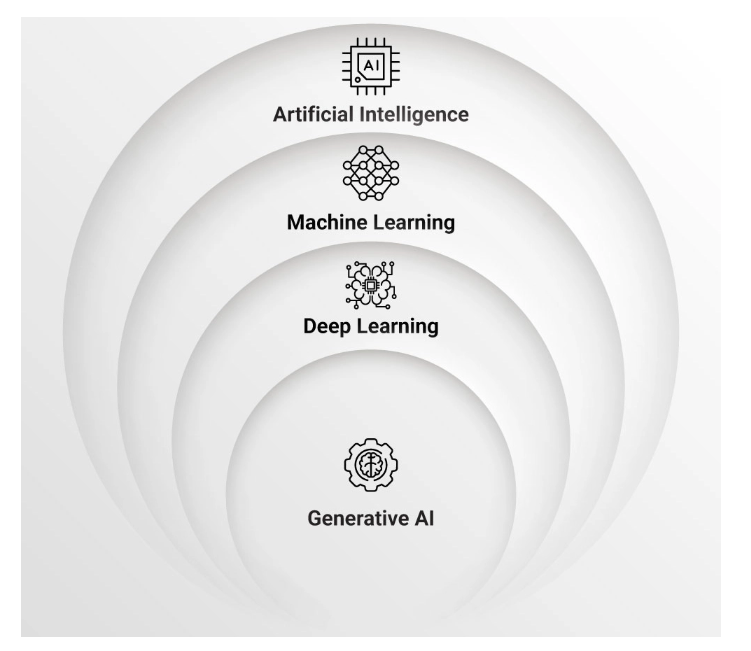

Evolution of AI
This section describes the evolution of AI over the last 7 decades.
Expert Systems
Expert Systems were promising AI solution in the very early phases of AI evolution. However, very quickly it was realized that it will not be suitable when the system is complex.
Machine Learning
This section gives an overview of the Machine Learning techniques.
Generative Models
These models are designed to create new, original content. They are built using machine learning models in variety of architectures. Refer Generative Models for details.
References
Turing, A. M. (2007). Computing machinery and intelligence. In Parsing the Turing test: Philosophical and methodological issues in the quest for the thinking computer (pp. 23-65). Dordrecht: Springer Netherlands. https://ebiquity.umbc.edu/file_directory/papers/1389.pdf
Goodfellow, I., Bengio, Y., Courville, A., & Bengio, Y. (2016). Deep learning (Vol. 1, No. 2). Cambridge: MIT press. (https://www.deeplearningbook.org/)
 Dr. Selvaraj Vadivelu