Execution Excellence through 4DX

“Strategy is a commodity, execution is an art. “

Peter Drucker

Strategy needs to be executed for achieving the desired outcomes. In the book titled ‘The 4 Disciplines of Execution: Achieving Your Wildly Important Goals”, the authors McChesney, C., Huling, J., Covey, S and Kaiker, R share their insights in the form of 4 disciplines which leaders and employees have adopted to produce results. I am sharing a brief description of these disciplines here for your quick reference.

The four disciplines of execution are:

  1. Focus on the wildly important
  2. Act on the lead measures
  3. Keep a compelling scoreboard
  4. Create a cadence of accountability

Focus on the wildly important: ‘Focus on less and accomplish more’ is the message here. We can easily relate to this as we tend to accomplish those few goals that we treat as ‘must-do’. Time and effort that we can invest in anything is bounded by constraints and hence prioritizing what is important and narrowing down the focus to the wildly important goals is the first step in execution excellence.

Act on the lead measures: They say “What gets measured gets done”. What we measure, track and act too needs a shift. Typically the focus is on the lag measures which track the outcome of the wildly important goal. Instead this discipline expects a shift to track and act upon lead measures which lead to the lag measures (or) the final outcome. This way we work on what we can influence.

Keep a compelling scoreboard: Individuals and teams need to know where they are with respect to the goal and through the lead and lag measures. A compelling scoreboard created by the team and accessible to them will create an engagement within the team improving the chances of successful outcomes.

Create a cadence of accountability: Having identified the wildly important goal, the lead measures to measure and track and a compelling scoreboard the team is ready to execute. During execution there should be a regular tracking and review mechanism which is brief and effective focused on the accountabilities of each individual for achieving the wildly important goal. SCRUM methodology uses daily standup meetings for this. In this meeting the individuals make commitments and update the progress on their commitments.

These 4 disciplines of execution excellence are practical and impactful. The book provides simple tools to aid in the adoption of these disciplines by teams and organizations. For more details, you can watch the introductory video and refer the book: McChesney, C., Huling, J., Covey, S. (2016). The 4 Disciplines of Execution: Achieving Your Wildly Important Goals. United Kingdom: Free Press.
Preparing industry-ready managers!

Management institutes prepare students into managers for the industry through well established methods. I had the opportunity to share my perspectives on this topic to a group of management faculty based on my experience as a practitioner, teacher and student. I am sharing a gist of my talk here.

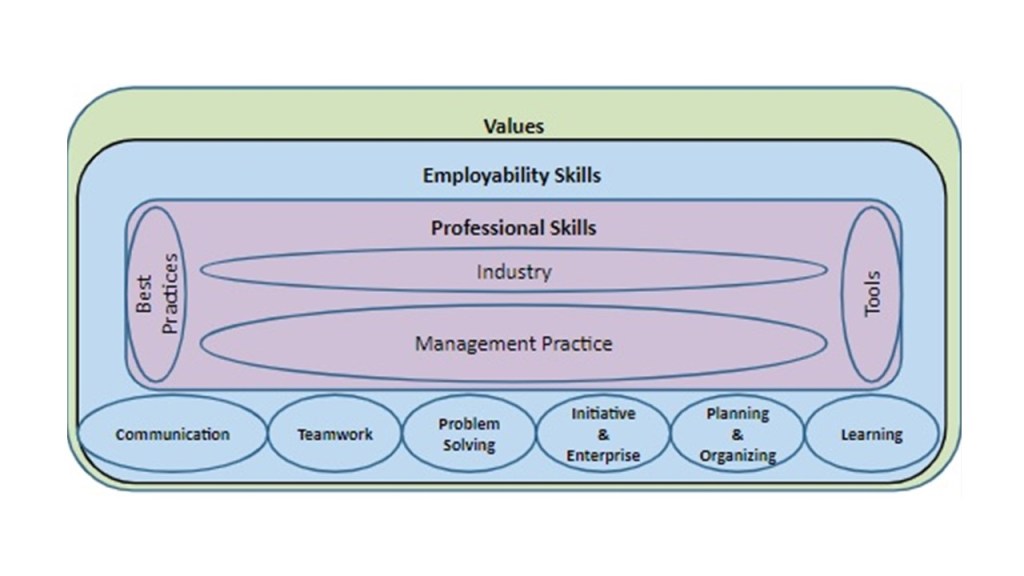
What does it take to be an industry-ready manager?: I have summarized what I found published and what I could relate to based on my experience in the picture above. At the core is the value system. Values serve as the canvas for any profession and management is no exception. For example, ‘Integrity’ is a value which is expected of every manager. I have grouped the skills into ‘Employability Skills’ and ‘Professional Skills’. The employability skills are common across professions and I found a good grouping of these in a published report (Gibb, J. (2004). Generic Skills in Vocational Education and Training: Research Readings. National Centre for Vocational Education Research (NCVER)). They are Communication, Teamwork, Problem Solving, Initiative & Enterprise, Planning & Organizing and Learning skills. I have grouped the professional skills required for managers into ‘Management Practice’, Tools and Best Practices. These can be viewed in two parts – Generic and Industry-specific as different industries have their specific needs and the management concepts, techniques and practices get evolved for their specific context. Besides these three professional skills, an awareness of the industry in which the management professional is working is key to be successful.

With this backdrop on what it takes, let us dwell into how to enable management students become industry-ready. It is well accepted practice in good management institutes to weave experiential learning with conceptual learning. I had the chance to see this really work in my experience of grooming project managers on the job and teaching them the concepts in an internal project management academy setting within my organization. The typical coursework in management institutes covers the concepts very well coupled with assignments and case discussions. I would like to emphasize on the industry immersion through internships and live industry projects. The success of this will depend on the involvement of the industry sponsor/advisor, the faculty identified and the student. Sufficient time should be provided for the industry immersion with appropriate credits. Besides these, students need to be connected with industry leaders through forum like expert talks and mentorship programs. Internal societies/clubs are also a great way to create industry-like experience within campus. Students will have to carefully choose the industry they would like to focus on and pick the projects/internships accordingly. Professional certifications by industry forums do help in many cases. Students should consult industry leaders/mentors in choosing these considering the returns for their efforts and money invested.

I hope this information is useful to the management faculty and management students. Look forward to your views, comments and any additional inputs.

Learn lifelong!

“What we have learned is like a handful of earth; What we have yet to learn is like the whole world” – Translated from a Tamil quoteKatrathu Kaiman Alavu Kallathathu Ulagalavu” by Avvaiyar, a 4th Century Tamil poet from India.

This was true then, is true today and will be true anytime in the future too!  Each of us have a chance to learn and contribute to the Knowledge as much as we can during our lifetime.

Fortunately it is not as difficult as it seems. Albert Einstein has said, “Learning is not a product of schooling but the lifelong attempt to acquire it”. As we lead our life we keep learning every moment – life teaches us all the time. Besides, there are so many other sources and mechanisms to learn.

Let’s never let go of learning – let’s learn lifelong and share what we learn!

Happy Learning & Sharing!